There is a lot of learning that goes into becoming an artist — learning the basics of your medium, how to wrestle with the tension between concept and craftsmanship, and how best to communicate your ideas. This learning is, for the most part, exactly what is needed to become a stronger artist. It is useful and good, but at some point learning has to make way for experience, and learning through training must make way for learning through practice.
This has been the case for me in the years following graduate school. My thesis artwork reflected a particular time in my artistic practice, a time of significant growth. After leaving graduate school, I mostly continued along some of the same lines as the thesis artwork, although my work gradually began to shift, reflecting a change in location and new themes in my life. This body of work carried me through to 2022, a year of significant personal change, and also the year that I began to feel unsatisfied and stifled with what I was creating.
It has taken years since my schooling to “unlearn” some of the ideas that I internalized throughout my art education, from high school through graduate school. Part of this is because the artistic training that I had, while much needed and wonderful, also fell on ears that were perhaps not ready to fully hear or absorb it. It is only in examining my own assumptions about what my artwork is or isn’t, or what I think it should be (but isn’t), have I recognized areas in which “unlearning” needed to happen in order to make way for learning new ways of making.
One of these areas was my belief about artwork scale. For many years I was sure that for artwork to be significant, it had to be large. It may not fill a room, but it had to have a presence. Part of this was personal preference — it is more fun to paint a head or figure lifesize. Part of this was my assumption that to be a successful painter, I had to make large-scale artworks. I liked to imagine myself boldly covering the canvas surface, filling as much space as I could. What I have now learned is that an artwork can have many different kinds of presence, from loud and bold, to quiet and powerful. I think about one of my favorite artworks, Edward Hopper’s Nighthawks, and my surprise when I saw it in a museum. For such an iconic artwork, it is certainly not wall-sized, at almost three feet wide and five feet long. Yet this medium sized artwork is highly engaging. Just as people communicate in different ways, so does the scale of the painting surface and how it interacts with the subject matter. Allowing myself to smaller artworks has been a personal challenge in the last couple of years as I explore how to make a small painting with presence.
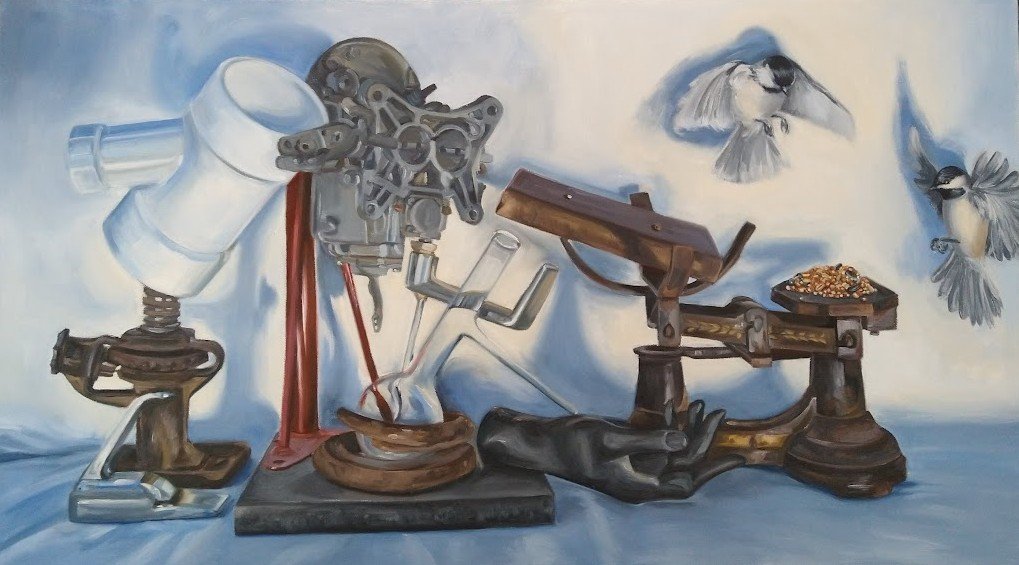
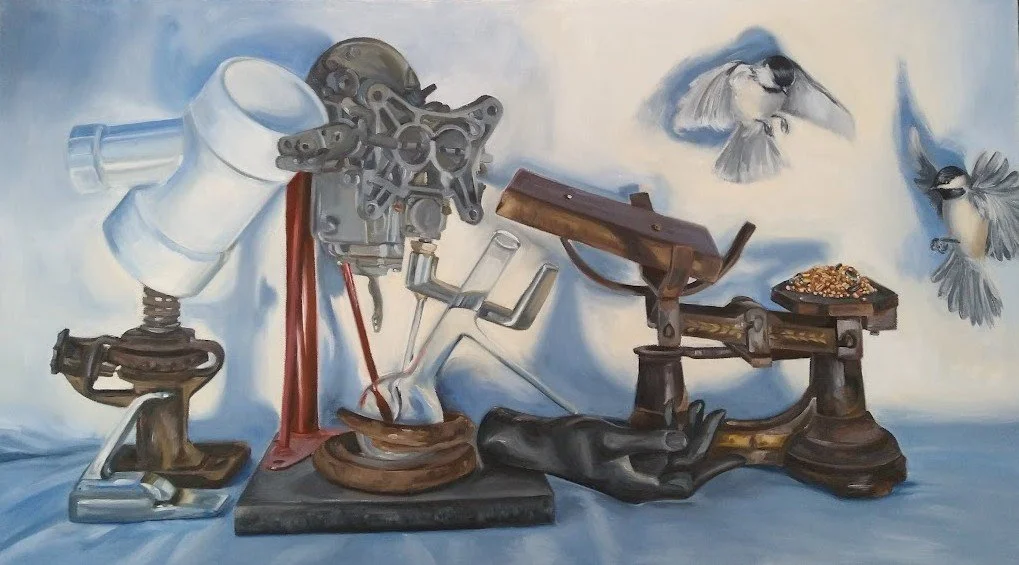
I also believed that a narrative could only exist in a figure painting. Yet I have increasingly been drawn to creating narrative through still life painting. Some of the most well known still life paintings in western art history such as the Dutch Golden Age floral arrangements, tabletop arrangements by Cézanne, or even the cubist works of Picasso and Braque, contain hints of a narrative or in some cases, a complex network of symbolism. These paintings leave room for interpretation and suggest a presence beyond the objects without actually including a figure.
Another idea I had, which had partially to do with career success rather than artmaking, was my belief that artists should be consistent in theme or style. The artist needed to have a definite path that they were walking, and couldn’t deviate far from that, whether in subject matter or approach, in order to be successful. While many artists create a somewhat cohesive body of work, they also experiment with different ways of artmaking, and often their current path was found through exploring a range of subject matter and styles. The Kansas-based artist Lester Raymer stands out in my mind as an example of an artist who experimented with a range of styles and materials, yet produced an overall identifiable, consistent body of artwork. Even unusual styles or techniques within his oeuvre stand out as a delightful surprise, rather than evidence of an inconsistent artist. Many of Raymer’s artworks demonstrate a return to certain subject matter in a variety of materials, as one of the greatest consistencies in his artwork was making what he liked to look at. I will venture to say that perhaps my own interests will naturally lead me to create a consistent body of work. And perhaps following the path of my varying interests will lead me to be a more content, if not successful artist in the long run.
Deconstructing old ideas about artmaking and learning new ones was helped along by hearing the experiences of other artists. I started listening regularly to the Undraped Artist Podcast, hosted by artist Jeff Hein. On this podcast, Jeff interviews many different professional artists (mostly painters) about their journey as an artist, painting/making techniques, art philosophy, etc. Hearing the vast differences between these artists and their artistic journey demonstrated to me that we all approach artmaking differently, whether our journey has been straight or meandering. This also reminded me that success as an artist was defined by the individual artist, and that all types of training and experiences could prove valuable. There isn’t one path to success.
The interesting thing about “unlearning” is that it is not actually deleting or negating any previous education, but allowing it to take a back seat for a time so new learning can take place. Just like pruning a plant, unlearning leaves room for growth and flourishing. The ideas and experiences I had about scale, subject matter, and success as an artist were not inherently wrong, but they could only bring me so far. It is through making room for new ideas that I am able to move forward as an artist.