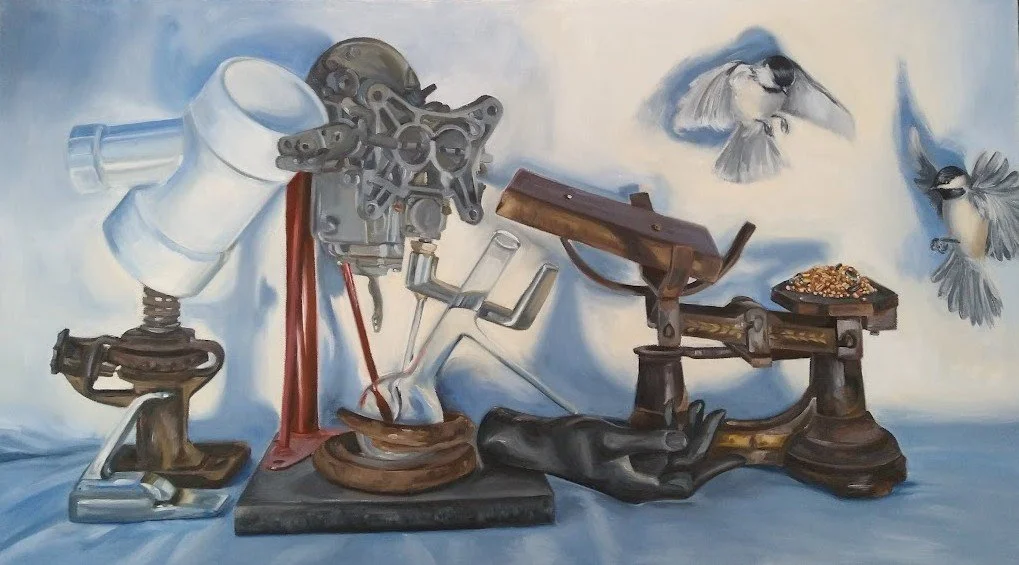
The idea for this painting originated at the end of a period of creative stagnation combined with a difficult work situation, both of which left me searching for a metaphor to express my personal turmoil. I envisioned a “machine” that was a collection of random objects, put together in such a way that they appeared possibly functional, but weren’t, much like the broken institutions we are often a part of and the brokenness that we all embody. What would this machine produce? Completely illogically, it would produce birdseed.
While birdseed has many connotations, I primarily thought about the birds in Jesus’ parable of the Sower. In Matthew 13, Jesus tells of a farmer who goes out to sow his seed, a parallel to the spread of the gospel on the hearts of the listeners. This farmer sows seed on the path where it is eaten by birds, spreads seed on rocky places and thin soil, and sows on thorny ground. Finally, some of the seed falls on good soil and produces a crop. Two things stand out to me in this parable - first, that the farmer (standing in for God), still goes out and sows his seed on a variety of ground, fully knowing that it will not all flourish. Secondly, that the birds in this parable represent the “evil one” who snatches away the gospel “sown” in the hearts of listeners. But earlier in the book of Matthew, Jesus assures his followers that they are much more valuable than the birds of the air, which God provides for daily. The birds in this painting could be interpreted in dual ways as well, as they either hover threateningly over the birdseed or gracefully accept the provision given and the promise of fruitfulness inherent in seeds.
A feeling of futility is one that has haunted me for the past few years, but I couldn’t name. I have always believed that doing my best usually produces positive results. And while this can be true, there are situations where my best still isn’t good enough. I encountered this feeling a few years ago when I was with a family member recovering from an accident in the hospital. There was nothing I could do to relieve my loved one’s pain, and at a critical moment, I was seemingly unable to communicate the seriousness of their suffering to the nurses. Similarly, in the institution that I was a part of, no matter how hard I tried, I could not fix the brokenness I saw around me. But through the creation of this painting I was reminded that while the institution may be akin to a broken machine, we are all broken machines in need of the grace that holds us, carries us, and puts us back together again into usefulness.
Not part of the machine, but equally important in the composition, is the manikin hand in front, lying open, perhaps helpless, but also open to give and receive. An open-handed attitude, like that of the farmer in the parable, allows for us to receive undeserved grace and to produce unexpected results. The open hand also serves as a reminder that the results of our labor isn’t up to us to determine, but we are still called to labor faithfully. Even when our labor appears futile (like throwing good seed on a road, rocky ground, or thorns), we are still called to persevere. Fertility may yet be possible.